WEB4-025 · WEB4
Institutional Memory Systems
Good institutions remember when people change.
01
Big idea
Good institutions remember when people change.
Picture
See the structure
The simple version
Explain it like I’m ten
A new principal arrives after the old one retires. A careful handover book explains past decisions, promises, repairs, rules, and unfinished work. The school remembers more than any one person.
Tell it at dinner
A story worth remembering
A new principal arrives after the old one retires. A careful handover book explains past decisions, promises, repairs, rules, and unfinished work. The school remembers more than any one person.
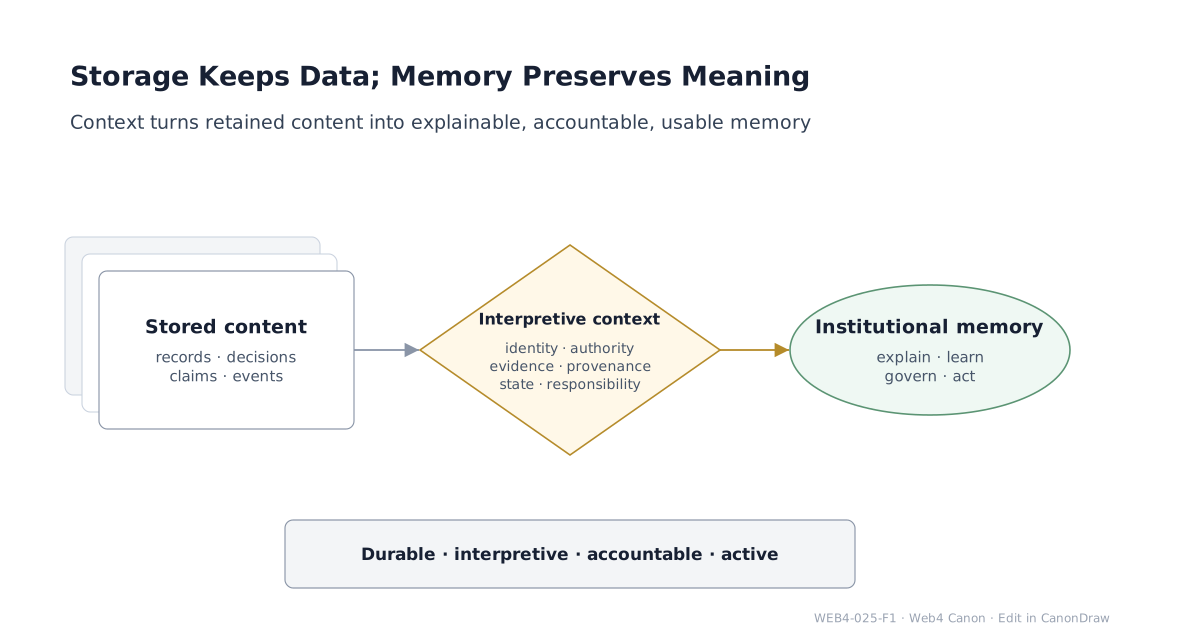
Now make the same problem larger: replace the children and ordinary objects with people, organizations, AI agents, robots, records, and resources moving at machine speed. Institutional memory preserves records, decisions, provenance, identity, authority, trust, claims, lifecycle state, and stewardship so organizations remain continuous and accountable. Durable memory reduces repeated mistakes, key-person dependency, and loss of legitimacy during turnover or crisis.
Pause at the moment the small system could go wrong. That is the design question the paper keeps in view: not whether people or helpers are clever, but whether the surrounding structure preserves the intended meaning when action scales.
That is why the small story holds: good institutions remember when people change.
Explain it to a CEO
Why leaders should care
Durable memory reduces repeated mistakes, key-person dependency, and loss of legitimacy during turnover or crisis. Institutional memory preserves records, decisions, provenance, identity, authority, trust, claims, lifecycle state, and stewardship so organizations remain continuous and accountable.
Explain it to an engineer
What the model means
Build retention, lineage, access, integrity, versioning, preservation, retrieval, and governance across heterogeneous records. Memory should preserve uncertainty and supersession rather than overwriting history.
Talk hook
An institution that forgets must repeatedly pay to relearn—and may repeat its worst decisions.
Ask the room
What essential knowledge would disappear if three key people left tomorrow?
Go deeper
The Canon is the source of truth.
WEB4-025 formalizes this structure: Institutional memory preserves records, decisions, provenance, identity, authority, trust, claims, lifecycle state, and stewardship so organizations remain continuous and accountable. The ordinary-life story is an intuition aid, not a replacement definition; the canonical paper remains authoritative for scope, terminology, limitations, and argument.
Read WEB4-025 — the authoritative paper →