WEB4-013 · WEB4
Intelligence as Infrastructure
Shared intelligence can become infrastructure, not just a collection of tools.
01
Big idea
Shared intelligence can become infrastructure, not just a collection of tools.
Picture
See the structure
The simple version
Explain it like I’m ten
Every house could dig its own little well, but the water might be dirty and some homes would have none. A town water system can serve everyone, watch quality, repair pipes, and improve the whole network.
Tell it at dinner
A story worth remembering
Every house could dig its own little well, but the water might be dirty and some homes would have none. A town water system can serve everyone, watch quality, repair pipes, and improve the whole network.
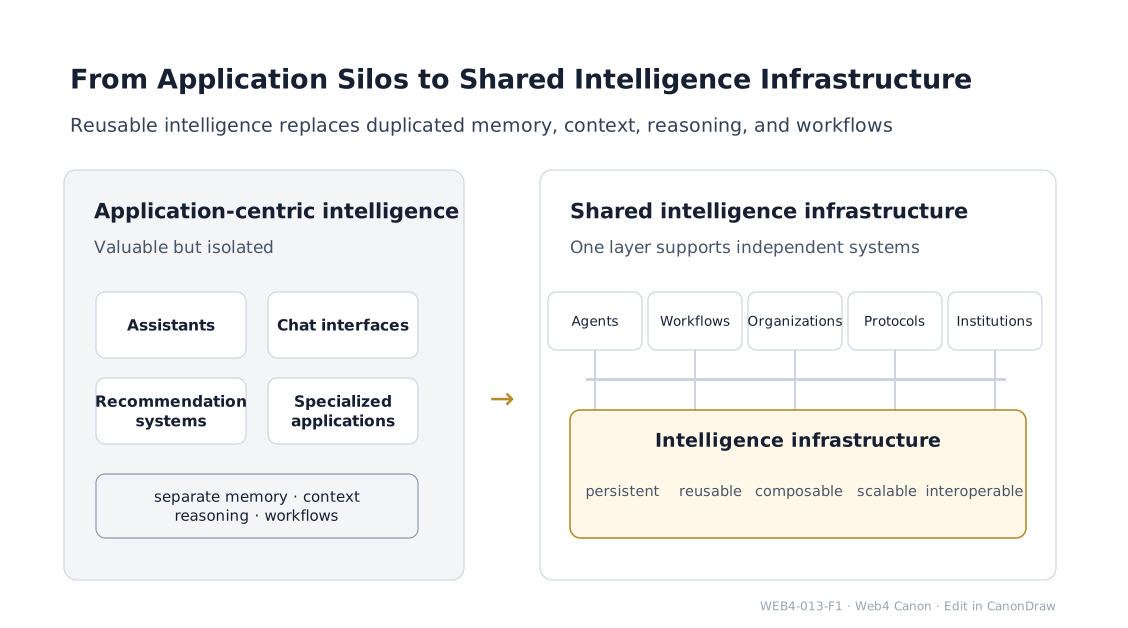
Now make the same problem larger: replace the children and ordinary objects with people, organizations, AI agents, robots, records, and resources moving at machine speed. Intelligence increasingly functions as a shared layer for coordination, adaptation, learning, decision-making, and execution across ecosystems. Treating intelligence as infrastructure shifts investment toward reliability, access, stewardship, interoperability, and public-interest governance.
Pause at the moment the small system could go wrong. That is the design question the paper keeps in view: not whether people or helpers are clever, but whether the surrounding structure preserves the intended meaning when action scales.
That is why the small story holds: shared intelligence can become infrastructure, not just a collection of tools.
Explain it to a CEO
Why leaders should care
Treating intelligence as infrastructure shifts investment toward reliability, access, stewardship, interoperability, and public-interest governance. Intelligence increasingly functions as a shared layer for coordination, adaptation, learning, decision-making, and execution across ecosystems.
Explain it to an engineer
What the model means
Design shared intelligence services with stable interfaces, observability, policy boundaries, provenance, adaptation, and failure handling. Infrastructure status increases governance obligations; it does not make intelligence infallible.
Talk hook
What changes when intelligence becomes as foundational as roads, electricity, or networks?
Ask the room
Who maintains and governs the intelligence infrastructure your institution depends on?
Go deeper
The Canon is the source of truth.
WEB4-013 formalizes this structure: Intelligence increasingly functions as a shared layer for coordination, adaptation, learning, decision-making, and execution across ecosystems. The ordinary-life story is an intuition aid, not a replacement definition; the canonical paper remains authoritative for scope, terminology, limitations, and argument.
Read WEB4-013 — the authoritative paper →