WEB4-020 · WEB4
Truth, Claims, and Verification
Important truth claims become stronger when evidence can be checked and challenged.
01
Big idea
Important truth claims become stronger when evidence can be checked and challenged.
Picture
See the structure
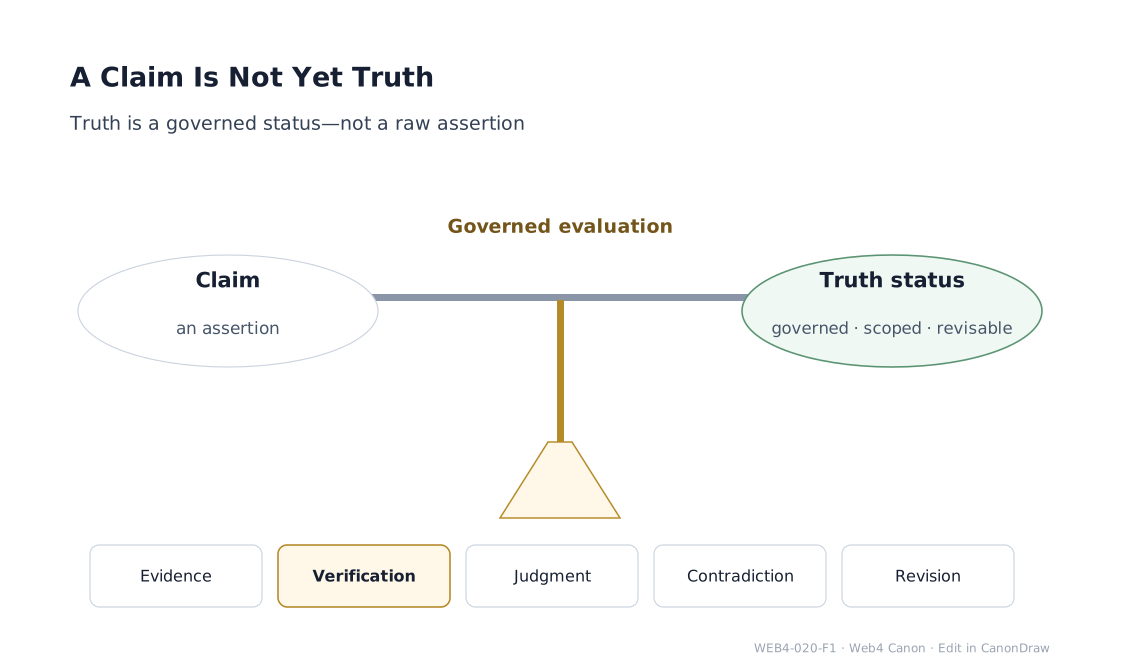
The simple version
Explain it like I’m ten
A child says her plant grew taller because she sang to it. At the science fair, she shows measurements, another child asks questions, and the judges compare what happened. They may agree, disagree, or ask for another test.
Tell it at dinner
A story worth remembering
A child says her plant grew taller because she sang to it. At the science fair, she shows measurements, another child asks questions, and the judges compare what happened. They may agree, disagree, or ask for another test.
Now make the same problem larger: replace the children and ordinary objects with people, organizations, AI agents, robots, records, and resources moving at machine speed. Web4 treats truth as a governed lifecycle of claims, evidence, verification, contradiction, judgment, revision, supersession, and appeal. Institutions gain a more honest alternative to both unverified assertions and rigid, irreversible truth labels.
Pause at the moment the small system could go wrong. That is the design question the paper keeps in view: not whether people or helpers are clever, but whether the surrounding structure preserves the intended meaning when action scales.
That is why the small story holds: important truth claims become stronger when evidence can be checked and challenged.
Explain it to a CEO
Why leaders should care
Institutions gain a more honest alternative to both unverified assertions and rigid, irreversible truth labels. Web4 treats truth as a governed lifecycle of claims, evidence, verification, contradiction, judgment, revision, supersession, and appeal.
Explain it to an engineer
What the model means
Model claims separately from evidence and verdicts; include verifier identity, method, scope, confidence, contradiction, versioning, appeal, and supersession. Verification outcomes should permit uncertainty.
Talk hook
In intelligent systems, truth is not merely asserted—it is processed.
Ask the room
Which high-impact claim in your organization cannot currently be challenged or revised cleanly?
Go deeper
The Canon is the source of truth.
WEB4-020 formalizes this structure: Web4 treats truth as a governed lifecycle of claims, evidence, verification, contradiction, judgment, revision, supersession, and appeal. The ordinary-life story is an intuition aid, not a replacement definition; the canonical paper remains authoritative for scope, terminology, limitations, and argument.
Read WEB4-020 — the authoritative paper →