WEB4-010 · WEB4
Agent Governance
Web4 is defined by governable agents, not merely intelligent ones.
01
Big idea
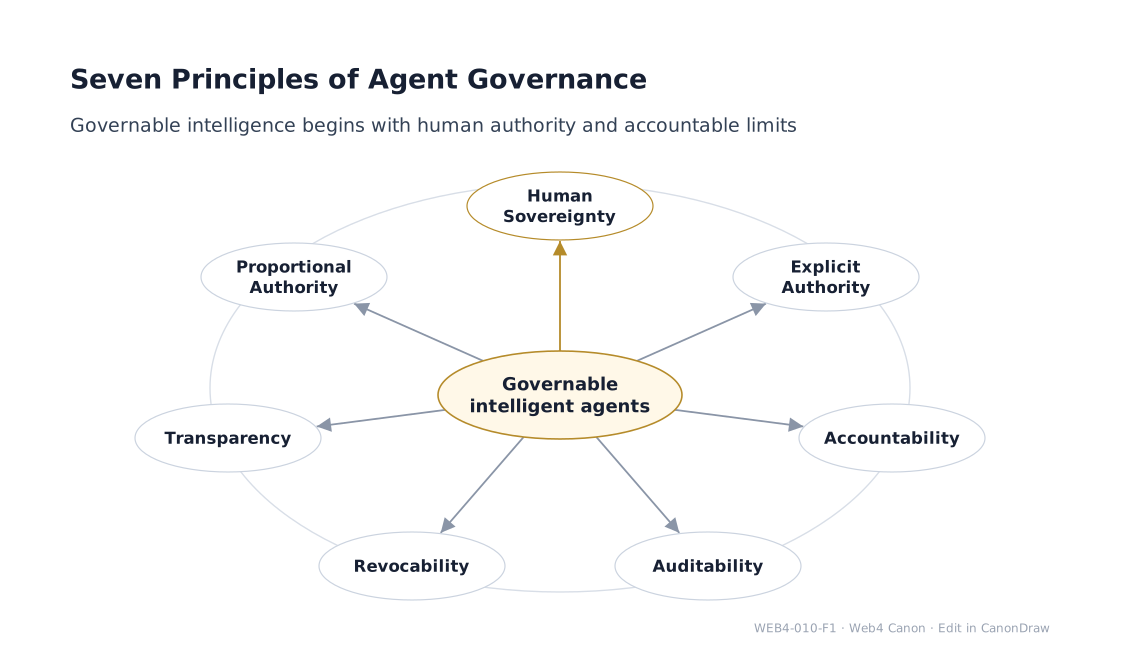
Web4 is defined by governable agents, not merely intelligent ones.
Picture
See the structure
The simple version
Explain it like I’m ten
A soccer team needs more than talented players. Players have positions, the captain coordinates, the referee stops unsafe play, and the league can review what happened. Skill makes the game exciting; shared rules keep it fair and playable.
Tell it at dinner
A story worth remembering
A soccer team needs more than talented players. Players have positions, the captain coordinates, the referee stops unsafe play, and the league can review what happened. Skill makes the game exciting; shared rules keep it fair and playable.
Now make the same problem larger: replace the children and ordinary objects with people, organizations, AI agents, robots, records, and resources moving at machine speed. Agent governance coordinates authority, delegation, trust, reputation, accountability, oversight, and correction across intelligent ecosystems. Leaders can scale autonomy while retaining mechanisms for supervision, review, intervention, and institutional legitimacy.
Pause at the moment the small system could go wrong. That is the design question the paper keeps in view: not whether people or helpers are clever, but whether the surrounding structure preserves the intended meaning when action scales.
That is why the small story holds: web4 is defined by governable agents, not merely intelligent ones.
Explain it to a CEO
Why leaders should care
Leaders can scale autonomy while retaining mechanisms for supervision, review, intervention, and institutional legitimacy. Agent governance coordinates authority, delegation, trust, reputation, accountability, oversight, and correction across intelligent ecosystems.
Explain it to an engineer
What the model means
Governance spans identity, policies, roles, constraints, monitoring, escalation, adjudication, and revocation across the agent lifecycle. It is broader than access control and should remain separable from model capability.
Talk hook
The question is not whether agents will be intelligent; it is whether they will be governable.
Ask the room
What happens after one of your agents makes a decision nobody expected?
Go deeper
The Canon is the source of truth.
WEB4-010 formalizes this structure: Agent governance coordinates authority, delegation, trust, reputation, accountability, oversight, and correction across intelligent ecosystems. The ordinary-life story is an intuition aid, not a replacement definition; the canonical paper remains authoritative for scope, terminology, limitations, and argument.
Read WEB4-010 — the authoritative paper →