WEB4-004 · WEB4
The Web4 Constitution
Freedom works better when everyone agrees on the rules of power.
01
Big idea
Freedom works better when everyone agrees on the rules of power.
Picture
See the structure
The simple version
Explain it like I’m ten
Children build a playground and invent games. At first, the biggest child changes the rules whenever he is losing. The group finally writes down rules that apply to everyone, including the rule-makers, and agrees how rules may change.
Tell it at dinner
A story worth remembering
Children build a playground and invent games. At first, the biggest child changes the rules whenever he is losing. The group finally writes down rules that apply to everyone, including the rule-makers, and agrees how rules may change.
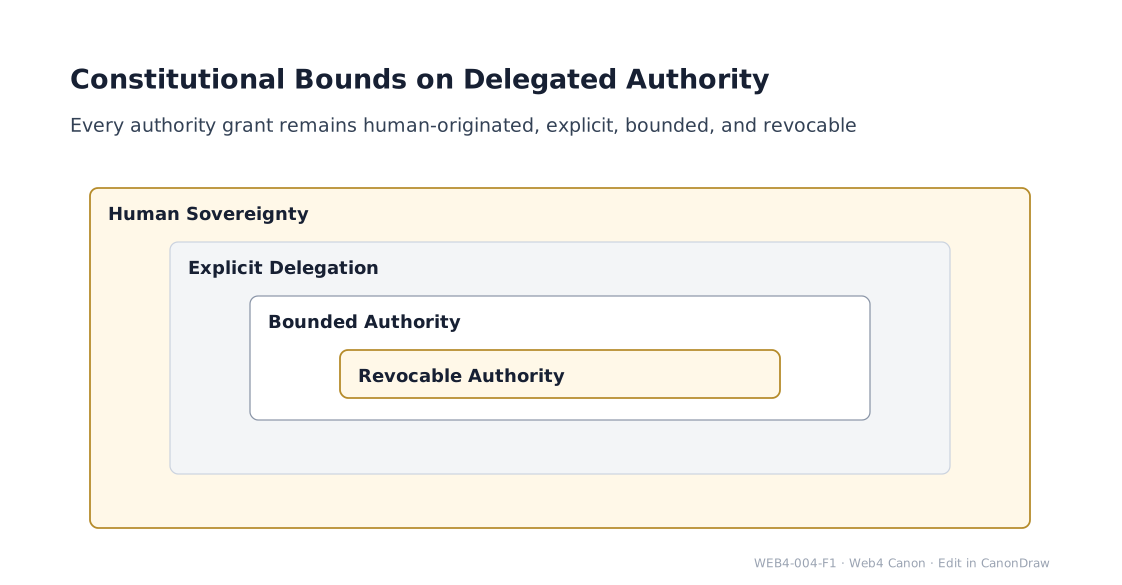
Now make the same problem larger: replace the children and ordinary objects with people, organizations, AI agents, robots, records, and resources moving at machine speed. The Web4 Constitution supplies durable principles and governance boundaries for delegated intelligence so power remains legitimate, accountable, reviewable, and revocable. A constitutional layer gives institutions stable limits that survive vendors, leaders, and individual policies, reducing arbitrary machine power.
Pause at the moment the small system could go wrong. That is the design question the paper keeps in view: not whether people or helpers are clever, but whether the surrounding structure preserves the intended meaning when action scales.
That is why the small story holds: freedom works better when everyone agrees on the rules of power.
Explain it to a CEO
Why leaders should care
A constitutional layer gives institutions stable limits that survive vendors, leaders, and individual policies, reducing arbitrary machine power. The Web4 Constitution supplies durable principles and governance boundaries for delegated intelligence so power remains legitimate, accountable, reviewable, and revocable.
Explain it to an engineer
What the model means
Constitutional principles should be projected into enforceable policies, review procedures, delegation constraints, registries, and appeals. The paper establishes normative infrastructure rather than a self-executing legal constitution.
Talk hook
Before we give machines power, what rules must even the rule-makers obey?
Ask the room
What principle should no agent, executive, or administrator be allowed to bypass?
Go deeper
The Canon is the source of truth.
WEB4-004 formalizes this structure: The Web4 Constitution supplies durable principles and governance boundaries for delegated intelligence so power remains legitimate, accountable, reviewable, and revocable. The ordinary-life story is an intuition aid, not a replacement definition; the canonical paper remains authoritative for scope, terminology, limitations, and argument.
Read WEB4-004 — the authoritative paper →