COOR-001 · COOR
The Complexity of Coordination: Why Governable Intelligence Becomes Essential at Scale
Coordination needs architecture as participants and dependencies multiply.
01
Big idea
Coordination needs architecture as participants and dependencies multiply.
Picture
See the structure
The simple version
Explain it like I’m ten
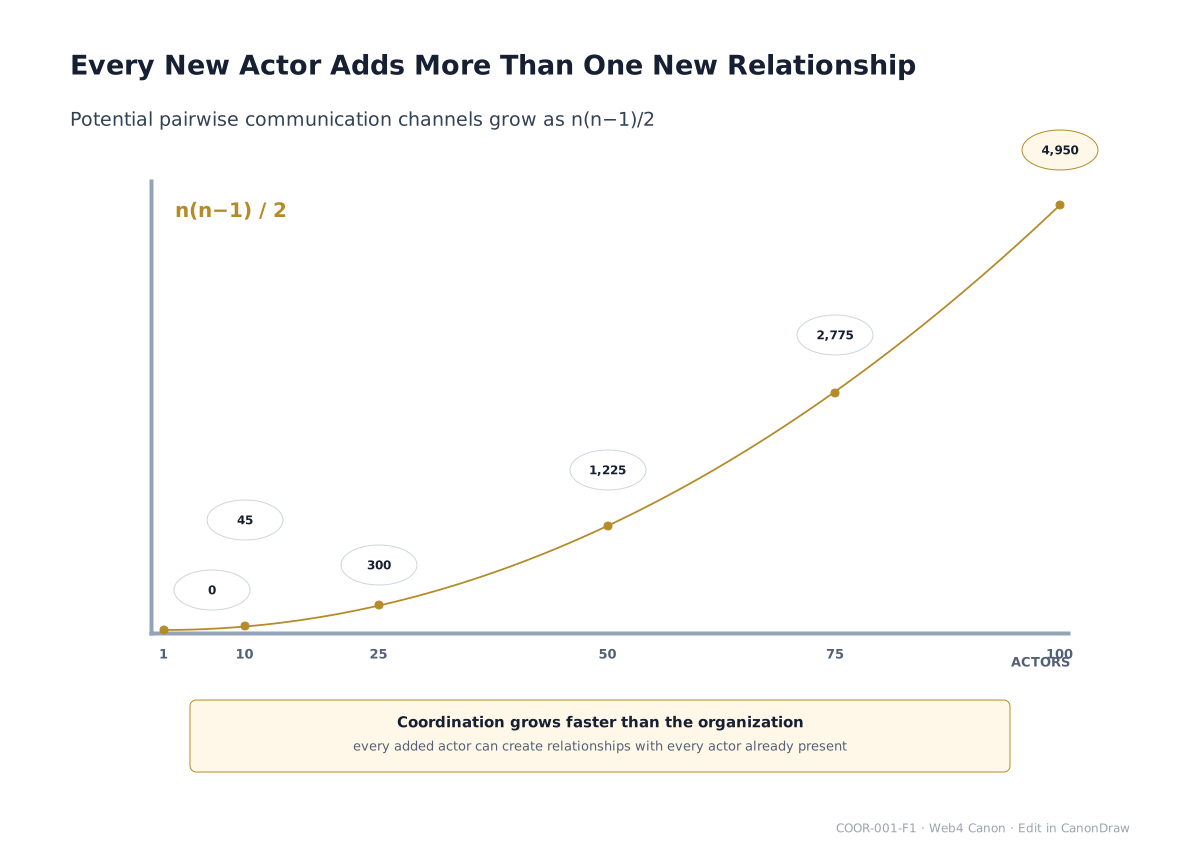
If ten cooks all shout to everyone, dinner becomes noise. A kitchen uses stations, order tickets, timing, and a head cook so chopping, baking, and serving come together without every cook talking to every other cook.
Tell it at dinner
A story worth remembering
If ten cooks all shout to everyone, dinner becomes noise. A kitchen uses stations, order tickets, timing, and a head cook so chopping, baking, and serving come together without every cook talking to every other cook.
Now make the same problem larger: replace the children and ordinary objects with people, organizations, AI agents, robots, records, and resources moving at machine speed. Coordination complexity grows beyond communication links to include contribution, delegation, artifacts, evidence, trust, incentives, and outcomes, making governable intelligence essential at scale. Leaders can increase organizational capacity without allowing coordination overhead and invisible dependencies to overwhelm performance and accountability.
Pause at the moment the small system could go wrong. That is the design question the paper keeps in view: not whether people or helpers are clever, but whether the surrounding structure preserves the intended meaning when action scales.
That is why the small story holds: coordination needs architecture as participants and dependencies multiply.
Explain it to a CEO
Why leaders should care
Leaders can increase organizational capacity without allowing coordination overhead and invisible dependencies to overwhelm performance and accountability. Coordination complexity grows beyond communication links to include contribution, delegation, artifacts, evidence, trust, incentives, and outcomes, making governable intelligence essential at scale.
Explain it to an engineer
What the model means
Model actors and communication, contribution, authority, dependency, artifact, evidence, trust, incentive, and outcome graphs; reduce unnecessary pairwise coupling with protocols, registries, orchestration, governance, and feedback.
Talk hook
Adding one more agent adds capacity—but it also adds relationships nobody may be governing.
Ask the room
Where has coordination complexity grown faster than your management architecture?
Go deeper
The Canon is the source of truth.
COOR-001 formalizes this structure: Coordination complexity grows beyond communication links to include contribution, delegation, artifacts, evidence, trust, incentives, and outcomes, making governable intelligence essential at scale. The ordinary-life story is an intuition aid, not a replacement definition; the canonical paper remains authoritative for scope, terminology, limitations, and argument.
Read COOR-001 — the authoritative paper →