WEB4-028 · WEB4
Authority-Native Economies
Healthy economies coordinate more than money.
01
Big idea
Healthy economies coordinate more than money.
Picture
See the structure
The simple version
Explain it like I’m ten
At a school fair, coins buy lemonade, but coins cannot make someone the team captain, prove a cake was checked for allergies, or show who cared for the class pet. Different kinds of value help the fair work.
Tell it at dinner
A story worth remembering
At a school fair, coins buy lemonade, but coins cannot make someone the team captain, prove a cake was checked for allergies, or show who cared for the class pet. Different kinds of value help the fair work.
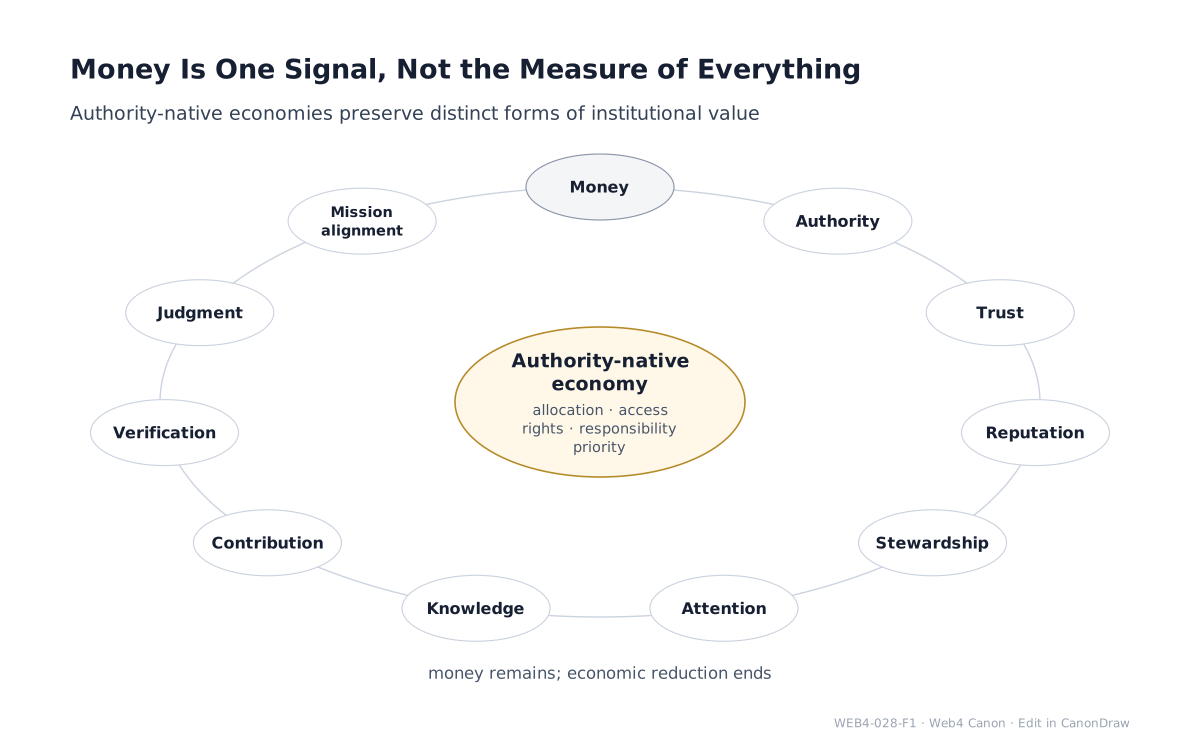
Now make the same problem larger: replace the children and ordinary objects with people, organizations, AI agents, robots, records, and resources moving at machine speed. Authority-native economies place money beside governed signals such as authority, trust, reputation, stewardship, attention, knowledge, contribution, and verification. Leaders can design richer institutional markets and allocation systems without pretending all value is price or making every right transferable.
Pause at the moment the small system could go wrong. That is the design question the paper keeps in view: not whether people or helpers are clever, but whether the surrounding structure preserves the intended meaning when action scales.
That is why the small story holds: healthy economies coordinate more than money.
Explain it to a CEO
Why leaders should care
Leaders can design richer institutional markets and allocation systems without pretending all value is price or making every right transferable. Authority-native economies place money beside governed signals such as authority, trust, reputation, stewardship, attention, knowledge, contribution, and verification.
Explain it to an engineer
What the model means
Compose typed native assets, registries, wallets, lifecycle, rules, incentives, and exchange mechanisms while preserving non-transferability and context where required. The paper does not propose one universal token.
Talk hook
What if the most important assets in the next economy cannot be bought?
Ask the room
Which allocation decision needs trust, contribution, or stewardship data in addition to price?
Go deeper
The Canon is the source of truth.
WEB4-028 formalizes this structure: Authority-native economies place money beside governed signals such as authority, trust, reputation, stewardship, attention, knowledge, contribution, and verification. The ordinary-life story is an intuition aid, not a replacement definition; the canonical paper remains authoritative for scope, terminology, limitations, and argument.
Read WEB4-028 — the authoritative paper →