WEB4-007 · WEB4
Registry-Based Coordination
A registry is shared memory for things people and helpers must find and verify.
01
Big idea
A registry is shared memory for things people and helpers must find and verify.
Picture
See the structure
The simple version
Explain it like I’m ten
A library would be confusing if every librarian kept a private list in their pocket. A shared catalog lets everyone see which books exist, where they are, who borrowed them, and which ones cannot leave the room.
Tell it at dinner
A story worth remembering
A library would be confusing if every librarian kept a private list in their pocket. A shared catalog lets everyone see which books exist, where they are, who borrowed them, and which ones cannot leave the room.
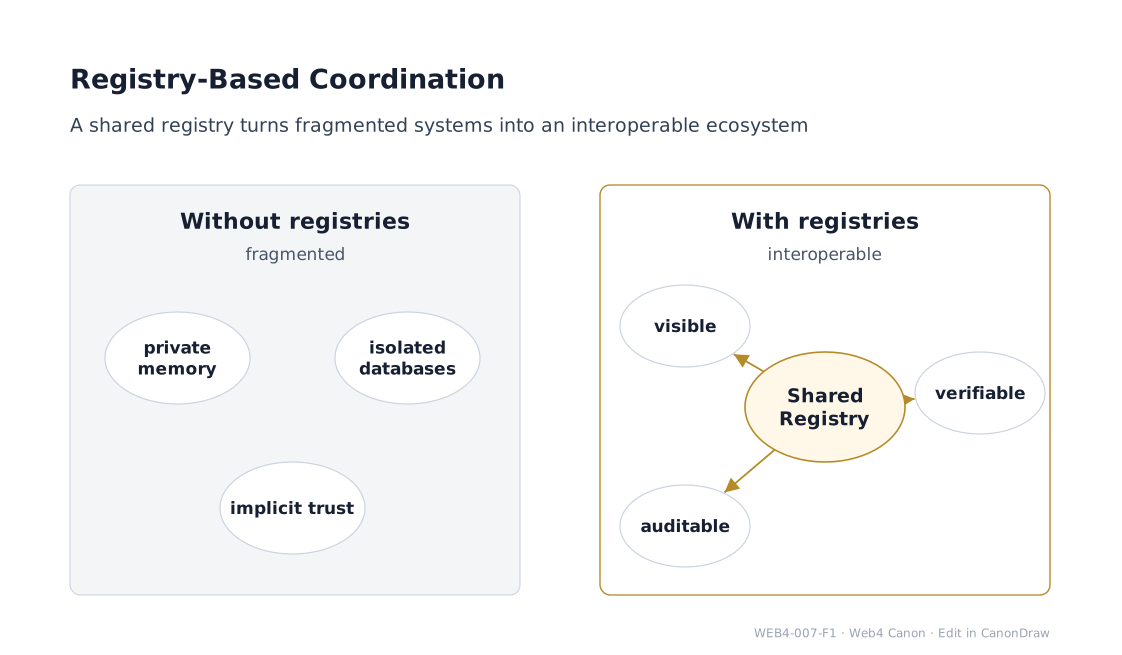
Now make the same problem larger: replace the children and ordinary objects with people, organizations, AI agents, robots, records, and resources moving at machine speed. Shared registries make identity, authority, credentials, delegation, workflows, and reputation visible and queryable enough for coordination at scale. Registries reduce reconciliation cost and ambiguity across organizations while creating an auditable basis for automated decisions.
Pause at the moment the small system could go wrong. That is the design question the paper keeps in view: not whether people or helpers are clever, but whether the surrounding structure preserves the intended meaning when action scales.
That is why the small story holds: a registry is shared memory for things people and helpers must find and verify.
Explain it to a CEO
Why leaders should care
Registries reduce reconciliation cost and ambiguity across organizations while creating an auditable basis for automated decisions. Shared registries make identity, authority, credentials, delegation, workflows, and reputation visible and queryable enough for coordination at scale.
Explain it to an engineer
What the model means
Use authoritative records, schemas, lifecycle state, provenance, query semantics, and access controls. A registry records governed state; it should not be treated as automatically truthful merely because a record exists.
Talk hook
What if every agent carried a different private version of who was allowed to do what?
Ask the room
Which critical fact does your organization repeatedly reconstruct because no trusted registry exists?
Go deeper
The Canon is the source of truth.
WEB4-007 formalizes this structure: Shared registries make identity, authority, credentials, delegation, workflows, and reputation visible and queryable enough for coordination at scale. The ordinary-life story is an intuition aid, not a replacement definition; the canonical paper remains authoritative for scope, terminology, limitations, and argument.
Read WEB4-007 — the authoritative paper →