WEB4-035 · WEB4
Organizational Proof
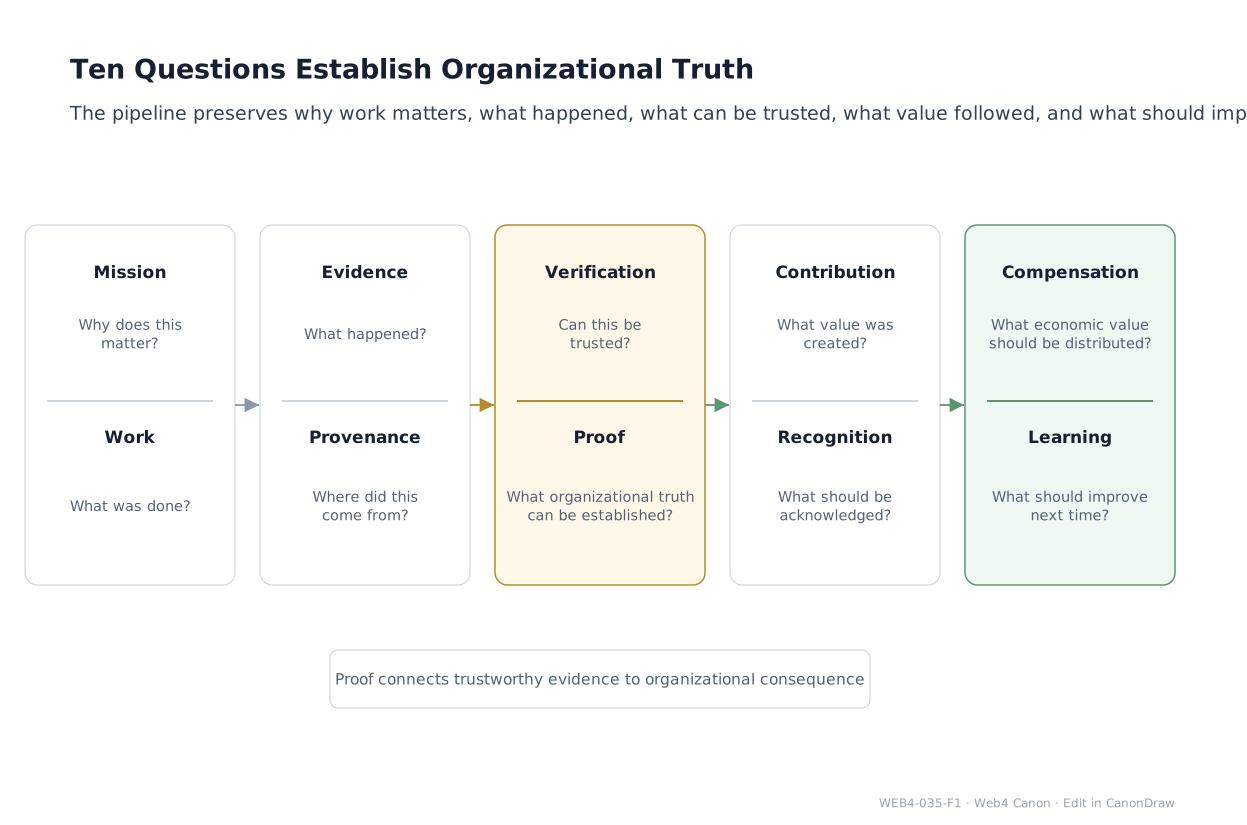
Organizational proof turns scattered evidence into a justified conclusion.
01
Big idea
Organizational proof turns scattered evidence into a justified conclusion.
Picture
See the structure
The simple version
Explain it like I’m ten
Children say their treehouse is safe. An adult checks the plan, the wood, the bolts, and photos of how it was built before anyone climbs in. The final check is stronger because it is tied to evidence.
Tell it at dinner
A story worth remembering
Children say their treehouse is safe. An adult checks the plan, the wood, the bolts, and photos of how it was built before anyone climbs in. The final check is stronger because it is tied to evidence.
Now make the same problem larger: replace the children and ordinary objects with people, organizations, AI agents, robots, records, and resources moving at machine speed. Organizational Proof establishes trusted, provenance-preserving proof of contribution as a foundation for recognition, incentives, governance, and learning. Organizations can replace opinion-driven attribution with reviewable evidence while preserving uncertainty and human judgment.
Pause at the moment the small system could go wrong. That is the design question the paper keeps in view: not whether people or helpers are clever, but whether the surrounding structure preserves the intended meaning when action scales.
That is why the small story holds: organizational proof turns scattered evidence into a justified conclusion.
Explain it to a CEO
Why leaders should care
Organizations can replace opinion-driven attribution with reviewable evidence while preserving uncertainty and human judgment. Organizational Proof establishes trusted, provenance-preserving proof of contribution as a foundation for recognition, incentives, governance, and learning.
Explain it to an engineer
What the model means
Separate evidence, provenance, verification, proof objects, claims, contributions, and trust. Proof should state scope, method, dependencies, verifier, limitations, and status rather than implying mathematical certainty.
Talk hook
Financial statements can be audited. Why is organizational contribution still mostly opinion?
Ask the room
What evidence would justify your most consequential recognition or resource-allocation decision?
Go deeper
The Canon is the source of truth.
WEB4-035 formalizes this structure: Organizational Proof establishes trusted, provenance-preserving proof of contribution as a foundation for recognition, incentives, governance, and learning. The ordinary-life story is an intuition aid, not a replacement definition; the canonical paper remains authoritative for scope, terminology, limitations, and argument.
Read WEB4-035 — the authoritative paper →