WEB4-022 · WEB4
The Native Asset Lifecycle
Valuable records need a visible lifecycle, not just a creation date.
01
Big idea
Valuable records need a visible lifecycle, not just a creation date.
Picture
See the structure
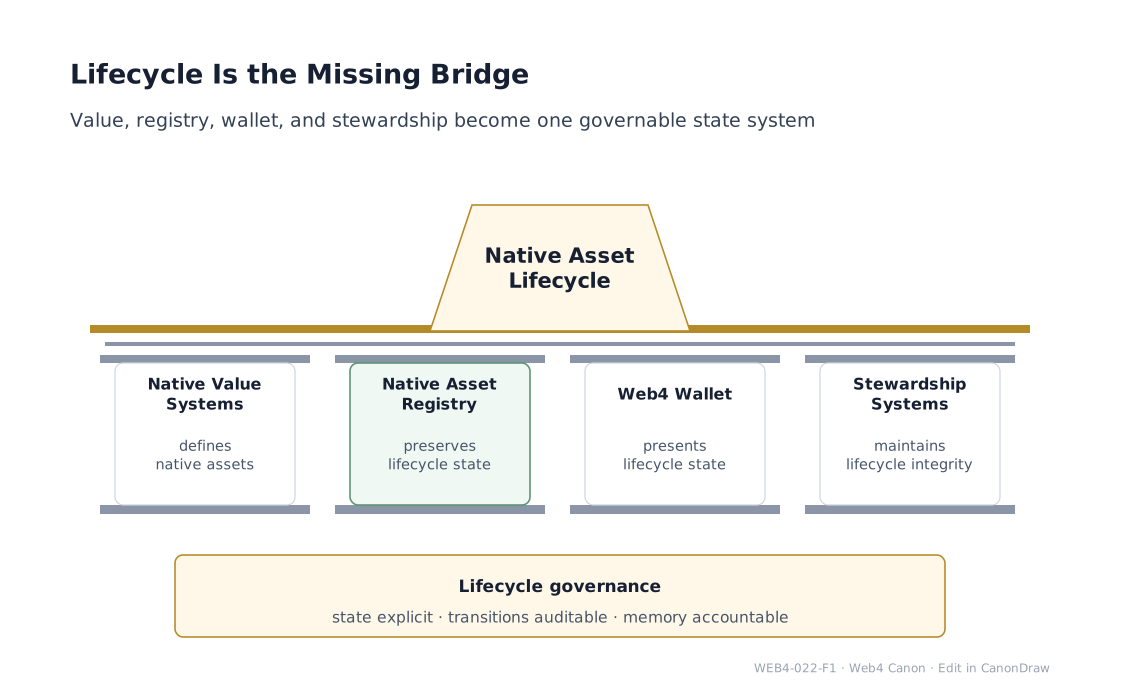
The simple version
Explain it like I’m ten
A library book is bought, labeled, placed on a shelf, borrowed, returned, repaired, and one day moved to the archive. At each step, people need to know its current state and who may change it next.
Tell it at dinner
A story worth remembering
A library book is bought, labeled, placed on a shelf, borrowed, returned, repaired, and one day moved to the archive. At each step, people need to know its current state and who may change it next.
Now make the same problem larger: replace the children and ordinary objects with people, organizations, AI agents, robots, records, and resources moving at machine speed. Native assets are dynamic stateful entities whose governed transitions make status, use, transfer, revocation, supersession, archiving, and memory explicit. Lifecycle governance prevents stale credentials, ambiguous ownership, and inconsistent handling of institutional assets.
Pause at the moment the small system could go wrong. That is the design question the paper keeps in view: not whether people or helpers are clever, but whether the surrounding structure preserves the intended meaning when action scales.
That is why the small story holds: valuable records need a visible lifecycle, not just a creation date.
Explain it to a CEO
Why leaders should care
Lifecycle governance prevents stale credentials, ambiguous ownership, and inconsistent handling of institutional assets. Native assets are dynamic stateful entities whose governed transitions make status, use, transfer, revocation, supersession, archiving, and memory explicit.
Explain it to an engineer
What the model means
Define a state machine with authorized transitions, invariants, actors, timestamps, evidence, provenance, and terminal states. Avoid treating mutable database fields as an implicit lifecycle.
Talk hook
Most governance failures begin when everyone sees the asset but nobody agrees on its state.
Ask the room
Which credential, claim, or authority record should have expired but still looks active?
Go deeper
The Canon is the source of truth.
WEB4-022 formalizes this structure: Native assets are dynamic stateful entities whose governed transitions make status, use, transfer, revocation, supersession, archiving, and memory explicit. The ordinary-life story is an intuition aid, not a replacement definition; the canonical paper remains authoritative for scope, terminology, limitations, and argument.
Read WEB4-022 — the authoritative paper →